
Clay County Parole Versus Probation
Parole and probation both involve rules in the community, but they begin in different systems. Parole follows a period in TDCJ custody and is governed by a Board decision, release certificate, and Parole Division supervision. Probation begins with a criminal court order. In Clay County, the local Community Supervision and Corrections Department, often shortened to CSCD, carries out that order. A person released on bond is not on probation merely because the person left jail.
| Point | Parole | Probation |
|---|---|---|
| How it begins | Release from TDCJ under a Board decision or mandatory supervision | A sentencing court orders community supervision |
| Clay contact | TDCJ Wichita Falls District Parole Office | Clay County Adult Probation and the sentencing clerk |
| Best proof | TDCJ record, Board result, and release certificate | Judgment or probation order plus CSCD confirmation |
| End record | Parole discharge or sentence completion | Court and CSCD completion or discharge record |
The source must fit the case. A blank parole search says little about a county probation case. Likewise, a court entry for community supervision is not proof of a TDCJ parole release. Check the name, date of birth, case or TDCJ number, county of conviction, and date observed before drawing a conclusion.
- Parole
- Conditional community release from state prison before the sentence fully expires.
- Probation
- Court-ordered community supervision, which Texas law and agencies often call community supervision.
- Discharge
- The formal end of custody or supervision shown by the responsible agency's record.
- Absconder
- A supervised person who stopped reporting and whose location is unknown to the agency.
Verify Clay County Post-Release Supervision
Start with the release path, not a guess. A Clay County Jail record may show bond, time served, a probation order, transfer to TDCJ, or transfer to another custodian. Only some paths lead to parole or probation. The Clay County released-inmate search and record process helps establish that first event. Then use the agency that owns the supervision record.
- Match the person with a stable identifier. Use a case number for court supervision or a TDCJ number for state parole when available.
- Read the court judgment. Community supervision language points to probation; a commitment to TDCJ points to state custody and a later possible parole review.
- For parole, check the TDCJ inmate search and call the Board status line at 844-512-0461 if a review result needs confirmation.
- For probation, contact Clay County Adult Probation and the clerk for the sentencing court.
- Confirm the assigned office. Residence and placement rules may send a parolee somewhere other than the county-mapped office.
- Record the status language and date. Approval, scheduled release, physical release, active supervision, and discharge are separate stages.
A favorable parole vote does not establish physical release. Programs, residence approval, a detainer, discipline, or release-plan work can keep the person in custody. Probation also should not be inferred from a jail disappearance. The signed judgment and CSCD record are stronger proof.
Clay County Supervision Offices
Clay County maps to the Wichita Falls District Parole Office in TDCJ Region V. That county map is a routing aid, not a public list of everyone on parole. A person may report elsewhere because supervision generally follows approved residence and placement. Call before visiting and ask only for information the office can lawfully disclose.
3100 Seymour Highway, Suite 118
Wichita Falls, TX 76301
940-322-2721
Fax: 940-766-4216
The official TDCJ county-to-office table shows the Clay assignment. The captured source below preserves that routing context.
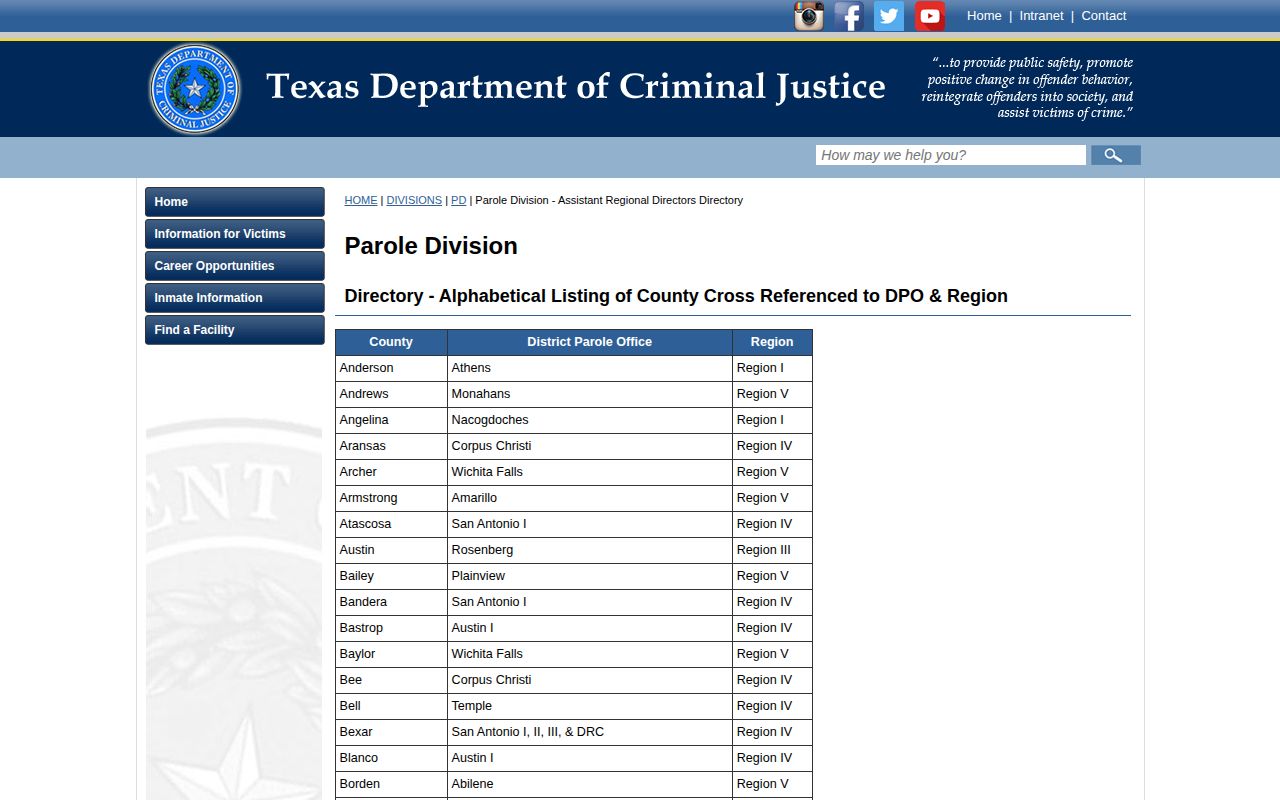
The map directs Clay parole questions to Wichita Falls, while local probation questions stay with Clay's CSCD and court.
Ricky Watson, Community Supervision Officer
210 N. Bridge Street
Henrietta, TX 76365
Mail: 214 N. Main, Henrietta, TX 76365
940-538-6022
Fax: 940-538-4431
Clay Supervision Violations and Warrants
Conditions are the rules stated in a parole certificate or probation order. They may address reporting, approved residence, travel, programs, fees, or conduct, but the exact terms come from the person's own record. A claimed violation does not by itself show the final outcome. The officer, court, or Board process must act on it.
An active parole warrant can cause a person released from Clay County Jail to be detained again. Report each event on its own terms: release from Clay custody, execution of a warrant, and custody under TDCJ authority. TDCJ defines an absconder as a person who stopped reporting and whose location is unknown. Its anonymous tip line is 866-680-6667. The public Sex Offender Absconder Search covers only a limited class, not all people on parole or probation, and TDCJ warns that fingerprints are the only sure identity check.
Notification tools have a narrow role. Texas IVSS can carry state custody or parole events when the record is in its scope, but an alert should be checked against TDCJ or the local office. Silence from an alert service does not prove compliance or discharge.
Note: A Clay jail release and a later supervision warrant are separate events and should be verified with separate custodians.
How Clay County Supervision Ends
Supervision ends through a formal act, not merely because a name vanishes from a search. For parole, the useful proof is a TDCJ discharge entry, release history, certificate, or other record tied to the sentence. A request may be sent through the TDCJ public-information process. Identify the person, TDCJ number, requested event, and date range. Texas Government Code Chapter 552 applies to existing public records, though lawful exceptions and redactions may limit what is released.
Probation completion belongs to the sentencing court and CSCD. Ask for the judgment, supervision order, later modification, revocation, or discharge document that fits the case. Do not send a judicial-record request to the Sheriff's general records email. Clay's county notice warns that a department receiving a misdirected request need not forward it, and judicial records follow a separate route.
Words matter here. “Off supervision” may mean successful discharge, expiration, revocation, transfer, or a data gap. Quote the official status and date. If the record conflicts with a live agency statement, preserve both observation dates and ask the record holder to reconcile them.
Clay Parole Review Is File-Based
Texas does not conduct a formal public individual hearing for an ordinary parole or mandatory-release review. Board panels review and vote on files. Open Board meetings address policy and public business; they do not decide individual cases. A meeting calendar therefore is not a Clay County person's parole hearing date.
The Board panel FAQ states this distinction, and the official review process explains file review. The source capture below shows why a public meeting should not be reported as an individual release proceeding.
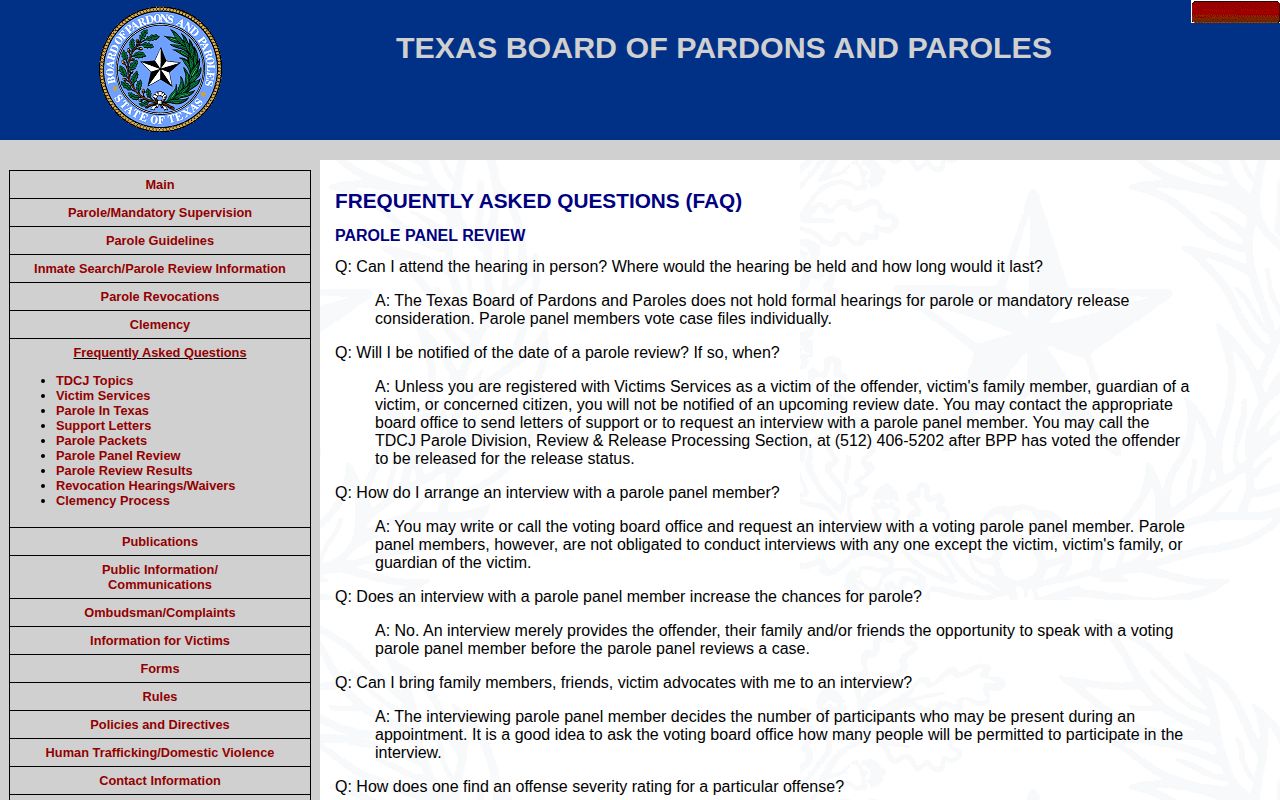
A person can have a review underway, a vote, an approval with conditions, a scheduled date, and later an actual release. Each stage needs its own source.
Clay Parole Decisions Have Stages
Eligibility, review, approval, scheduling, release, supervision, and discharge are not synonyms. The inmate search may show review information. The Board line confirms results, while vote options explain codes. Processing then checks programs, plans, and detainers.
An approved person may remain in custody. A person released from Clay jail may be held on a parole warrant. State each event with its agency and date.
At the end, formal discharge is stronger evidence than disappearance from a portal. Request the record when the distinction matters.
Clay Probation Needs Court Proof
Clay probation begins with a court order, not a Board vote. Read the judgment, then confirm administration with Adult Probation. “Community supervision” in the judgment is stronger evidence than a blank parole search.
District felony records belong with the District Clerk and re:SearchTX. County-level cases use the County Clerk portal. Ask for a certified judgment, modification, revocation, or discharge when proof matters.
A revocation can return a person to custody. An amended order can change conditions. The CSCD should not be asked to interpret a TDCJ parole case it does not own.
Clay Supervision Status Sources
A Board result, a release certificate, and an active supervision record answer different questions. The Board's review-results channel can confirm the vote, while its vote-options page explains the decision code. Neither alone proves that release processing finished. For actual release and supervision, compare the TDCJ custody record with the assigned parole office.
Clay probation has its own chain. Begin with the sentencing judgment, then confirm the order with the local CSCD. If supervision has ended, seek the court or agency record that states completion, revocation, transfer, or discharge. This avoids reading silence in one portal as proof of a favorable outcome.
Every conclusion should preserve identity, custodian, status wording, and date observed. A short statement such as “on supervision” can become stale. A dated record tied to the correct TDCJ number or court case is far more useful.
A Clay County release notification can support the timeline, but it does not replace the supervision record. Texas IVSS-Counties concerns participating county events, while TDCJ IVSS concerns state custody and parole events. Match the alert to the agency before using it to describe supervision.
Preserve the date and exact event text for later agency confirmation.